

Cloudburst over Copenhagen
When the Sky Fell on Copenhagen
On the evening of 2 July 2011, more than 150 millimetres of rain fell on Copenhagen in about two hours. It was a once-in-a-thousand-years downpour, and the city's sewers never stood a chance. Streets became rivers, basements and even hospitals flooded, and the bill came to roughly six billion kroner in insurance claims alone.
The lesson landed hard. A warmer atmosphere holds more moisture, which means the storms that used to be freak events are quietly becoming the new design baseline. A year later, Copenhagen answered with the Cloudburst Management Plan: A citywide blueprint of around 300 separate projects, dimensioned to protect the city against a 100-year rain for the next hundred years. It is the reason Copenhagen is now described, at home and abroad, as the world's first purpose-built "sponge city."
What a Sponge City Actually Looks Like
The idea is deceptively simple. Instead of rushing every drop into a pipe and away, you let the city soak it up, hold it, and release it slowly, treating rainwater as a resource on the surface rather than a problem to be buried. In practice, that looks like a handful of now-famous places:
Tåsinge Plads in Østerbro was Copenhagen's first climate-adapted urban square. Around 1,000 square metres of tired asphalt became a small "Danish rainforest" that drains rain from roughly 8,000 square metres around it while doubling as a genuinely pleasant place to sit with a coffee.
Enghaveparken in Vesterbro was redesigned as a sunken "sponge park" that can hold around 25,000 cubic metres of water when a cloudburst hits, then drain back to being an ordinary neighbourhood park the rest of the year.
Karen Blixens Plads, one of the city's largest public squares, uses permeable paving to let water sink into the ground where it falls instead of running off.
Around twenty parks across the city have been reworked along these lines. But the sponge is only half the story. Beneath the greenery runs a second, greyer system: large cloudburst tunnels and pipes that carry the overflow from bigger storms out to the harbour. The photogenic parks are sold as the beaufication of the city that doubles as stormwater management while the tunnels quietly do a great deal of the heavy lifting.
Karens Minde: Climate Adaptation You Don't Notice
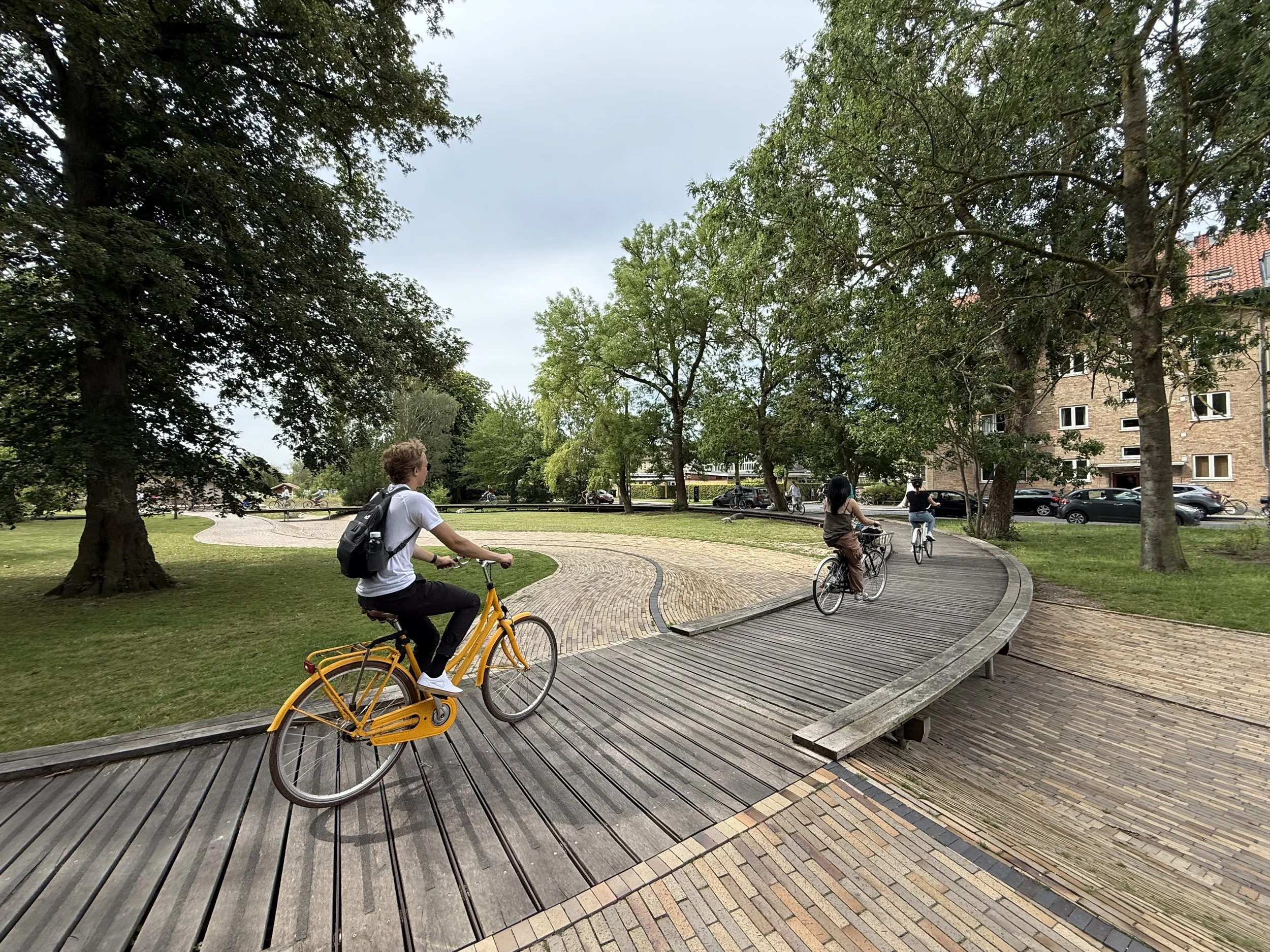
Cloudburst management meets nordic design
Head south to Sydhavn, the South Harbour, and you reach the project I'd send anyone to first. Karens Minde Aksen is a 600-metre ribbon of green running alongside Sjælør Boulevard and the Karens Minde culture house, through the neighbourhood locals call the Music Quarter. It's one of the city's more socially mixed and lower-income districts, with a fierce sense of place, semi-wild greenery, community life, dog runs, even horse paddocks, and what everyone involved describes as a genuine grassroots soul.
Two separate needs met on this low-lying strip. The district's urban-renewal programme wanted to stitch the neighbourhood together and give it a lift; the Cloudburst Plan had independently earmarked the same corridor as a route for storm water. Instead of letting those compete, the city fused them and climate funding became the lever to upgrade the whole area at once.
What makes the result quietly radical is its governing rule: add as much, and take away as little, as possible. Because residents already loved what was there, the design kept the playgrounds, the dog park and the paddocks and folded them into the new landscape rather than clearing the slate. And it was built with the neighbourhood, not just for it, with an extensive participatory process, with landscape architects Schønherr on design, GivRum running the citizen involvement, and WSP (formerly Orbicon) handling the engineering.
On an ordinary day, nobody experiences Karens Minde as flood infrastructure. You see a brick "riverbed" path winding through a park, benches, planting, a small lake. Only when a cloudburst hits does the path reveal its second job, carrying up to 15,000 cubic metres of water along its length, over reed beds and a "trickle meadow" that filter it clean before it reaches the lake. The southern stretch is deliberately left so wildlife and nature can flourish. Fittingly, it was voted Copenhagen's best urban space in 2023 and collected a row of climate and planning prizes besides.
The Asphalt Underneath
If Karens Minde is a story about what the sponge city can add, the pilot at Sankt Kjelds is a story about what it sometimes has to subtract, and from whom. When the city went looking for a neighbourhood to pilot the whole approach, it settled on Sankt Kjelds in outer Østerbro, and one of the reasons was not that it flooded worst, but that it had so much room to give.
The neighbourhood's streets covered around 270,000 square metres of asphalt, and planners calculated that roughly 50,000 of those could simply be handed back. By narrowing the streets to a sensible size, tens of thousands of square metres were freed for rain gardens, trees, and squares that hold water. Bryggervangen and Skt. Kjelds Plads that for years were wide, traffic-dominated arteries became the green heart of the district.
In other words, a good deal of what makes Copenhagen a "sponge" is land that used to be dedicated to cars. The water solutions we celebrate as nature returning to the city are, just as much, a story about the city reclaiming space it had over-allocated to the automobile decades ago.
The Numbers Behind the Green
The scale of the effort:
The full plan is budgeted at roughly 20 billion kroner (about €1.7 billion), split between water tariffs through the utility HOFOR, the municipal budget, and private landowners.
Originally slated for completion around 2032, the plan is still less than halfway there but the highest-risk areas have already seen their flood risk cut by an estimated 30 to 50 percent.
The oversized tunnels come with a bonus. During the dry, drought-stricken summers Northern Europe now faces, they double as reservoirs, holding water that can be tapped when the rain doesn't come.
It is also, notably, a good business case: the plan is projected to save more money in avoided flood damage than it costs to build.
Copenhagen's sponge city has become a genuine global reference point, studied by planners from Rotterdam to New York to Singapore. The limit on how "spongy" a city can become is really a question of how much street space it is willing to take back from cars.
Project Sources & Credits
Karens Minde Aksen — client: City of Copenhagen, as part of the Urban Renewal of Sydhavnen. Landscape architect: Schønherr. Engineering and delivery: WSP (formerly Orbicon). Citizen participation: GivRum. Contractor: Ebbe Dalsgaard. Completed 2023; a ~37,000 m² park that manages 15,000 m³ of cloudburst water.
If you want to experience Copenhagen's climate adaptation firsthand, from sponge parks and cloudburst streets to the everyday urban life they make possible, Nordic Path offers tailored tours connecting the policy, the design, and the people who live with it.
