
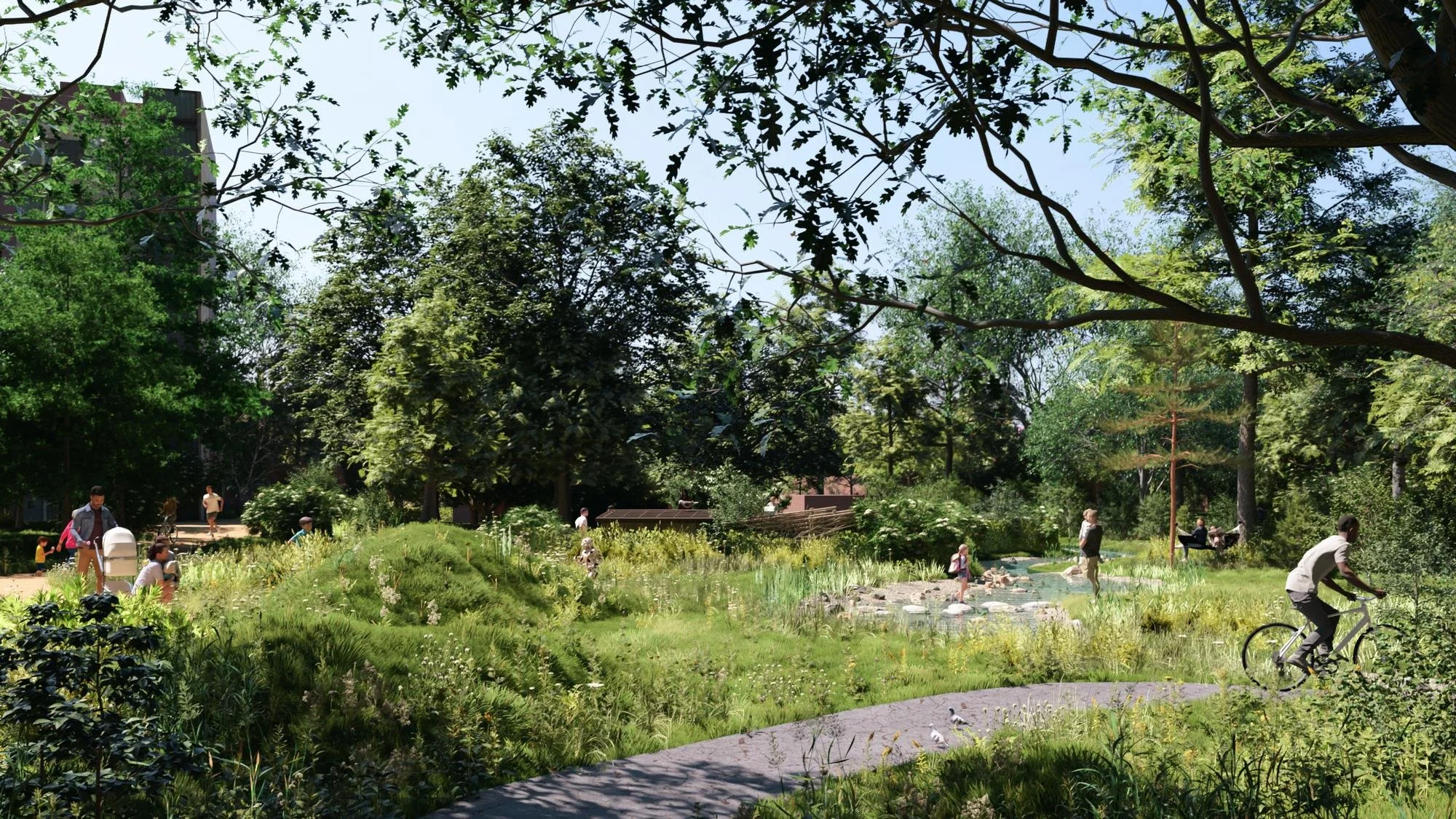
New park with stream flowing, illustration by SLA for Københavns Kommune
Copenhagen has agreed its budget for 2027. The first of the new political era that began with the 2025 municipal election, signed by a broad group of eight parties from across the political spectrum. Behind the top-line figure of roughly 2.3 billion kroner in capital investment across 2027–2030 sits a long list of decisions that will reshape the city's streets, waterways, and neighbourhoods: buried rivers brought back to the surface, new bylivsgader and outdoor-dining streets, money for affordable housing, another round of cycling improvements, more trees and a returning city gardener and, in the same breath, (slightly) more parking for cars.
The annual budget is the least glamorous document in city politics and one of the most revealing. It is where ambition meets the spreadsheet, and where you can read, line by line, what kind of city Copenhagen actually intends to build next year. What follows is our highlights of the 2027 agreement through the lens we care about most at Nordic Path: Urban transformation, mobility, water and greenery, housing, and public space. Covering what the budget prioritises, what it quietly reveals, and what to watch for once the plans reach the pavement.
A Broad Agreement in a New Political Era
This is the first budget of the new political constellation on Rådhuset following the 2025 municipal election, agreed by a broad coalition of SF, Enhedslisten, Socialdemokratiet, Radikale Venstre, Venstre, Liberal Alliance, Alternativet, and Dansk Folkeparti. Two parties, Konservative and Frie Grønne are not part of the agreement.
The parties frame their priorities as core welfare, more housing, a greener city, more life in the streets, and a lift for the elderly. In total, the agreement sets aside around 2,346 million kroner in capital spending across 2027-2030 and 995 million kroner in service spending in 2027. Tucked inside is a single combined package of 77 million kroner for byliv, parkering og begrønning - city life, parking, and greening the urban space. That one bundle, holding those three words together, is the whole budget in miniature: the tension between reclaiming the street for people and keeping it available for cars, negotiated in the same breath.
The technical committee that governs streets and public space is now called the Klima-, Miljø- og Teknikudvalget - the Climate, Environment and Technology Committee, with climate moved to the front of its own name. Under climate, environment and technology mayor Line Barfod, this budget spends money on adapting the city to a future with increasing amounts of rain.
Opening the City's Buried Streams
The most striking move in the 2027 budget is that Copenhagen is beginning to dig up rivers it once buried. For most of the twentieth century, the logic ran the other way. Streams were seen as obstacles: they were culverted, paved, and forgotten so that roads and buildings could run over the top. Now the city is starting to reverse that. The budget sets aside 6.2 million kroner to reopen Lygte Å in the park at Bispeengen by bringing a historic watercourse back to the surface as a recreational, nature-based feature. In parallel, 20.2 million kroner goes to a new water element in the Fremtidens Grøndalspark, carried out together with the cloudburst project on Harrestrup Å.
The budget also sets aside money for a new master plan for De Indre Søer, the inner lakes, with money for water quality, biodiversity, and more natural lake edges, and a traffic study for the streets that ring them. Readers of our piece on Søringen (find that article here) - the lakeside motorway that never got built - will feel a particular resonance here. The budget also funds continued pre-analysis of transforming the Ågade-Åboulevarden-H.C. Andersens Boulevard-Amager Boulevard corridor, with a separate study of re-establishing the Rådhushaven garden along H.C. Andersens Boulevard. This is the axis where Bispeengbuen still rises above the neighbourhood at second-floor height, and where the old Ladegårds Å runs hidden beneath the asphalt. A city that once dreamed of pouring motorways over its water is now studying how to bring the water back.
Byliv: The Street as a Living Room
Part of the 2027 budget is allocation for more “byliv” activating third spaces and transforming streets and plazas to more inviting spaces to linger and enjoy public spaces. The centrepiece is an expansion of the Bylivsgadepuljen - the "city-life street fund" - with 23.2 million kroner for 7 to 9 green bylivsgader, streets remade around residents' own project ideas, and in the process permanently removing up to 12 parking spaces at street level. A dedicated bylivsgade on Hovedvagtsgade is named first priority among the initiatives still awaiting full funding, alongside flagship public-space projects stretching from Bremerholm toward Kongens Nytorv and Højbro Plads. Beyond those, the parties commit on paper to a further 8 to 11 green bylivsgader in coming rounds.
Café and restaurant life gets a push too. The trial of extended outdoor serving in the Medieval City is widened to five more streets, and the fee and inspection regime around udeservering is being cut - supervision reduced by 75 percent from March 2027 and the charge lowered accordingly. More tables on the pavement, in other words, and less friction to put them there. There is money for temporary green urban rooms in the Medieval City, a strategic public-space plan for Vanløse's centre, and a technical study of turning the streets around Børsen into a single connected space.
And then there is the small line that may matter most in the long run: 0.9 million kroner for a foranalyse af bilfrie gader - a preliminary study of car-free streets. It is a modest sum for a potentially big impact idea, and it is the kind of quiet first step that, in Copenhagen, has a habit of becoming policy a few budgets later.
Homes People Can Afford
A city can reopen its rivers and green its streets, but if only the wealthy can afford to live beside them, the transformation is an exclusive fix for a selected few. Alongside greenery and byliv, ensuring that more homes can be built is named as one of the budget's top priorities and much of the housing money is aimed at affordable homes.
The budget is strengtens Copenhagen's almene boliger, the non-profit, social housing that has long been a backbone of a mixed city. The budget sets aside 2.3 million kroner a year to strengthen the municipality's capacity to actually deliver an increased number of these homes, in response to a new national housing proposal. Alongside it sits a distinctly Danish instrument: the andelsbolig, or cooperative flat, a middle path between renting and owning that has historically kept a home within reach of ordinary incomes. The city commits 30 million kroner in 2027 to keep supporting new cooperative associations, stepping in to buy and temporarily hold 120–150 cooperative flats so those associations can form.
The budget also moves to defend the affordability that already exists. A new opsøgende boligpatrulje - a proactive housing patrol, funded at 6.8 million kroner a year - will inspect rental housing, crack down on illegally high rents and sub-standard klubværelser, and issue fines, with a further 4.7 million kroner a year to handle the resulting cases at the rent tribunal. Looking further ahead, the work on Planstrategi 2027 and Kommuneplan 2028 includes money to study converting existing buildings - underused offices and the like - into housing, a route to new homes within the planetary boundaries.
Developing on One of the Worlds Best Bikeable Cities.
Cycling may not be the headline this year, but the budget is careful to say, in its own words, that it should become easier to be a cyclist in Copenhagen. We have sampled a few of the highlights here:
Nørregade becomes a cykelgade. A flagship project worth 18.5 million kroner turns Nørregade into a bicycle street, extending the cykelgade already established on Vendersgade. This is the model we explored in our piece on Copenhagen's Cykelgader, now pushed into the heart of the Medieval City.
Vester Voldgade gets its trial. The budget funds a cykelgade trial on Vester Voldgade, running from summer into autumn 2027. Vester Voldgade was our central example of car-normativity in the green-waves piece (Read more about that here) - a street rebuilt for people whose traffic lights were never reprogrammed to match. A bicycle-street trial is an answer to that critique.
More green waves, now data-driven. On top of the 15 corridors decided in the 2026 budget, the city funds additional green waves for cyclists - and, notably, a GPS-based monitoring system so the timings can be tuned continuously.
Bigger junctions and paths. There is 18.1 million kroner to rebuild Søtorvet, described as Denmark's largest cycle intersection, connecting one of the world's busiest bikelanes on Dronning Louises Bro (~40,000+ crossings a day), with the inner city and furthermore 15 million kroner to widen and light the cycle-and-pedestrian path through Amager Fælled between Artillerivej and Ørestads Boulevard. Both lean on co-funding from the national cycle pool, along with new cycle lanes on Frederiksholmsbroen and Nyholmsbroen and a wider path through Tingbjerg.
The Parking Paradox
At the same time as the city funds bylivsgader that remove parking, a separate parking sub-agreement moves in the opposite direction. It creates 191 new parking spaces and, combined with an earlier deal from June 2026, brings the total to 561 new spaces, concentrated especially on Østerbro. Some of this comes from converting parallel parking to angled parking on Østerbro and in the inner city, a change that squeezes more cars into the same kerb length but typically at the expense of the space beside it: the room that might otherwise widen a footway, hold a tree, or shelter a bike lane. Up to 200 street spaces are earmarked for residents in the dense brokvarterer where occupancy already runs at 90 percent or more.
But the same agreement also raises the price of a residents' parking permit:
The permit for an electric car, hydrogen car, or electric motorcycle rises from 1,270 to 1,905 kroner a year - roughly a 50 percent jump for the very vehicles the city has spent years encouraging.
The cleanest petrol and diesel cars move up to around 2,940 kroner from 1,905.
And the permit for a car whose consumption is not registered leaps from 2,670 to 6,305 kroner - more than doubling.
The direction is progressive: pollute more, or leave your consumption undocumented, and you pay more to store your car on public land. Even electric drivers now pay meaningfully more for the privilege of parking, an implicit acknowledgement that a parked car takes the same public space whatever comes out of its exhaust.
Greener by Degrees
Around these larger moves sits a layer of greenifying the city, however on a modest level. The budget funds 150 to 200 new trees, an expansion of the fund for facade-planting pits, and the careful transplanting of 45 to 55 mature trees standing in the path of the coming M5 metro line rather than felling them. The city will also hire a stadsgartner - a city gardener, a concept that we know from Danish cities in the form of a city architect. The budget also explores a bynaturregnskab, an urban-nature account to track whether Copenhagen is actually meeting its own targets for trees, planting, and biodiversity.
The agreement also launches a ten-year model for maintaining Copenhagen's building portfolio (2027–2036), part of a wider renovation plan the city frames at roughly 854 million kroner a year over the coming decade. Schools, nursing homes, job centres, day-care institutions, libraries, sports halls, and office buildings are to be upgraded and their energy ratings improved, with a target of lifting at least 30 percent of the municipal portfolio to energy label B or better by 2035, in line with the city's Klimastrategi 2035. It is telling that the budget's most consequential climate move is not a park or a bike lane but a decade-long programme to stop the city's own buildings leaking heat — the kind of deeply unglamorous work that does far more for emissions than it will ever do for a photograph.
What the Budget Chooses
Read as a whole, the 2027 budget shows a city widening its ambitions. Copenhagen is opening its old waterstreams, treating the street as a place to linger, builds on its ambition to be the be best bikeable city in the world and keeps the city within reach of people of ordinary means. Every budget is, in the end, a set of choices about what kind of city to build next.
We will be watching to see which of these promises reach the pavement.
These were some of the highlights from the 2027 budget, if you want read more you can find the complete budget and political agreement on Copenhagen Municipalities website here
On a Nordic Path tour, we explore how Copenhagen became one of the world's most livable cities: its cycling infrastructure, its urban transformations, and the political choices behind them. A budget like this one is where those choices are written down and the streets are where you can see whether they were kept.
