
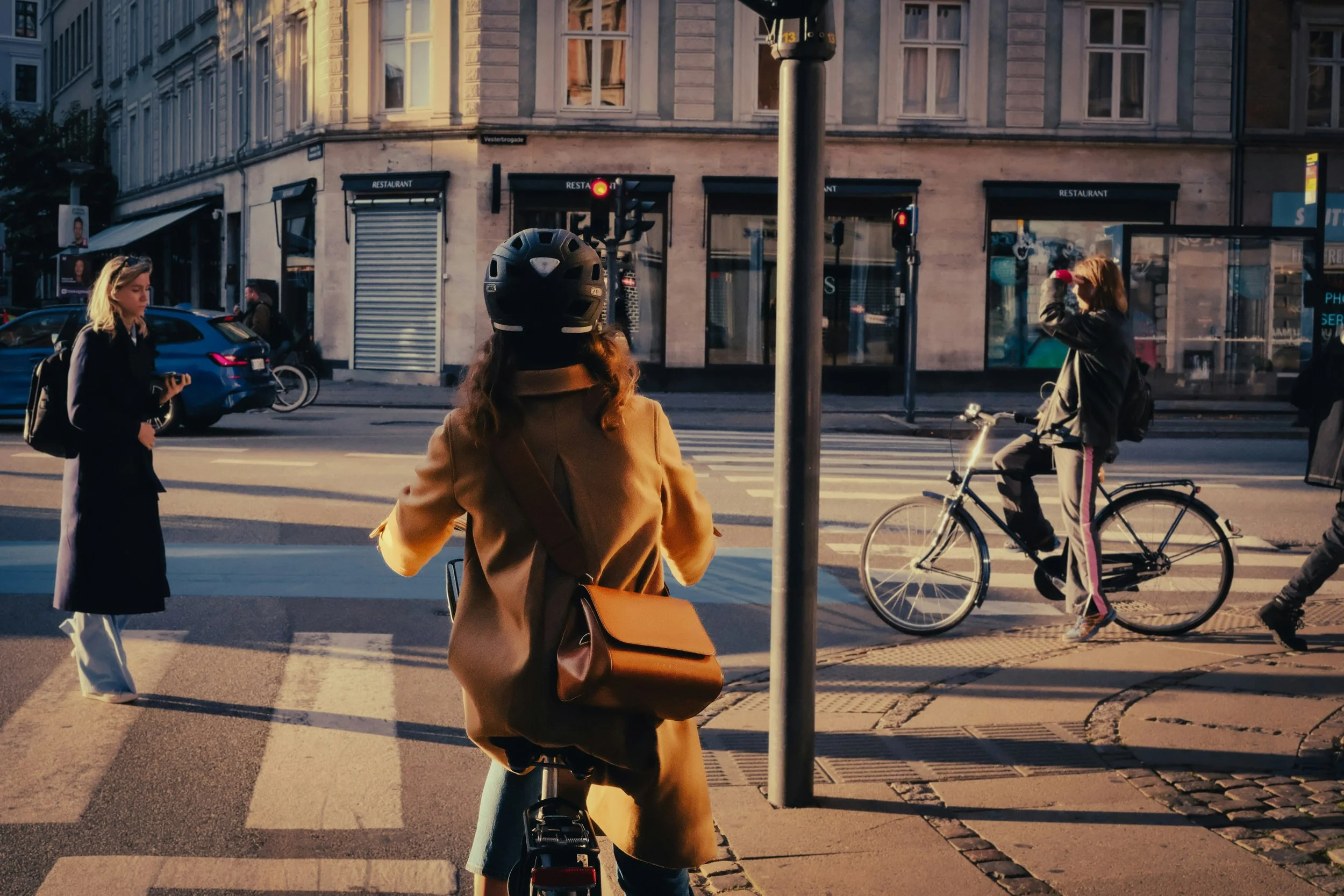
Woman on bike in Copenhagen
Published on March 8 - International Women's Day
Picture a Tuesday evening in Copenhagen. A woman finishes work, cycles to a daycare to collect a child, stops at a supermarket, drops groceries at an elderly relative's apartment, and rides home in the dark along a lit, kerb-separated path beside the lakes. None of that looks political. But almost every part of that journey, whether it feels safe, whether it is even possible by bike, whether the street was designed with her in mind is the result of choices the city made, or failed to make.
On International Women's Day, it is worth saying plainly: the transformation of streets and public space that Copenhagen is famous for is not gender-neutral. Good urbanism is quietly feminist. And a city built around the needs of women, or of anyone the current design leaves out, tends to be a better city for everyone.
The Invisible Traveler
For most of the twentieth century, transport planning optimized one trip: home to work and back, usually a man's rush-hour commute by car. The Spanish urbanist Inés Sánchez de Madariaga gave that blind spot a name: the mobility of care: the unpaid, everyday trips that keep a household running. The school run, the groceries, the pharmacy, the visit to a parent. These journeys are shorter, more frequent, chained together into complex loops, and made off-peak. Reflecting an unequal division of unpaid labour, they still fall disproportionately on women.
Studies across different cities put care trips at somewhere between a quarter and a third of all daily journeys, and consistently find that women make roughly twice as many care-related chained trips as men. Yet as Caroline Criado Perez documented in Invisible Women, we barely measured them, the data itself was built around the male commute, so the female pattern of movement simply disappeared from the statistics. A city that plans only for the nine-to-five commute is a city planning for half its residents.
The Geography of Fear
There is a second, harder layer. Public space does not feel the same to everyone after dark. The European Social Survey has asked people across nearly 30 countries how safe they feel walking alone in their area at night. In almost every one, women are between 2.5 and 5.7 times more likely than men to feel unsafe. In the UK, official figures found that 81% of women felt unsafe walking after dark in a park or open space, compared with 39% of men, and that around 44% of women aged 16–34 had experienced catcalling or unwanted sexual comments in the previous year. Global indicators tracked for the Sustainable Development Goals show women trailing men on feeling safe after dark by more than ten percentage points. And the burden is not evenly shared: single mothers, disabled women, and those on low incomes consistently report feeling least safe of all.
The consequence is both an inherent discomfort and a hidden tax on mobility. Women reroute around the underpass, avoid the empty platform, pay for a taxi, or skip the trip entirely. Fear quietly shrinks a person's access to the city. What reduces that fear is rarely more surveillance. It is design. Lighting, open sightlines, active ground floors, and simply other people around. Jane Jacobs called it "eyes on the street." A lively, mixed-use, walkable block is a safer block, while a street engineered for cars empties out at night and turns hostile. Livability and safety are two sides of the same coin.
Women as the Indicator
On the bicycle, all of this becomes measurable. Women's cycling rates track real safety conditions more closely than men's — studies have found, for example, that drivers tend to pass women cyclists more closely — so the share of women on bikes is one of the most reliable gauges of how safe cycling actually feels in a city. The urbanist Mikael Colville-Andersen and the Copenhagenize Index treat women as what planners bluntly call an "indicator species" of a bike-friendly city: where you see many women riding, the infrastructure is working.
In Denmark, women make up around 53% of cyclists; in the Netherlands, roughly 55%.
In cities with hostile infrastructure, the ratio flips, often three men for every woman on a bike.
The fix is not encouragement campaigns but separation: protected lanes, tracks wide enough for cargo bikes and children, and safe intersections. When New York City added protected lanes, women's cycling rose sharply. Portland's female share climbed steadily as its network grew.
Seen this way, Copenhagen's kerb-separated lanes, its bike-only bridges, and its new green waves are, whether anyone labels them so or not, feminist infrastructure. They lower the threshold of confidence a person needs to take part in the life of the city.
What Vienna Taught Us
The city that made this explicit is Vienna. In 1991, the planner Eva Kail staged an exhibition with a deceptively simple title: Who Owns Public Space? Women's Everyday Life in the City. It turned an uncomfortable question into policy. Vienna went on to build Frauen-Werk-Stadt, a residential district planned around women's daily routines by redesigning parks, footways, and lighting around how women actually move; and to retrofit the Mariahilf district with wider sidewalks and better crossings. Gender mainstreaming became a requirement for city planning. The lesson here is not that women need special treatment. It is that when you design for the most constrained user, someone pushing a stroller, carrying shopping, holding a child's hand, walking home after dark, you produce streets that work better for almost everyone: the elderly, disabled people, and children too.
Trust, the Nordic Gold
Denmark consistently ranks among the most trusting societies on earth. Roughly three-quarters of Danes say that most people can be trusted, and the country repeatedly tops European social-trust surveys. The Nordic Council of Ministers once called trust "the Nordic gold." Trust and public space feed each other. Danes famously leave babies napping in prams outside cafés, a habit that only makes sense in a city where the street feels safe and shared. Open, lit, lively public space generates the ordinary encounters that sustain social trust; fear and enclosure quietly erode them. A feminist city and a high-trust city turn out to be the same project seen from two angles. Both depend on a public realm that really belongs to everyone.
The City We Choose
Copenhagen has done much of this well, often without ever calling it feminist. However, car-normativity still shapes the budgets, and gender-disaggregated planning is far less explicit in Copenhagen than in Vienna. Every debate about more parking or more road capacity is, underneath, a debate about whose comfort the city is built to optimize. Because that is what street design ultimately is: A statement about who the city is for. Build for the confident driver and you get one kind of city. Build for the woman cycling home in the dark with a child on the back, and you get a city that works for nearly everyone else as well.
Whose city is it? Copenhagen's answer, street by street, should be simple: Everyone's.
On a Nordic Path tour, we explore how Copenhagen became one of the world's most livable cities: its cycling infrastructure, its urban transformations, and the political choices behind them. Questions of safety, care, and who gets to move freely through the city are one thread in that larger story, and they come sharply into focus once you see the streets up close.
